Rooibos, also called red bush tea or red tea, comes from South Africa, where Aspalathus linearis grows naturally. Unlike traditional tea, it does not come from Camellia sinensis. Known for being naturally caffeine-free, rooibos has become popular worldwide. The familiar red variety is processed differently from green rooibos, giving each a distinct colour and character.
The real difficulty begins when an everyday drink starts being treated like a health product. Knowing where sensible daily use ends, especially around concentrated products, medication, and unusually large amounts, makes the habit much easier to navigate.
Keep the Everyday Version Everyday
For most people interested in drinking rooibos regularly, the simplest place to start is ordinary rooibos sold as a beverage. The distinction matters because rooibos tea and concentrated rooibos products are not the same thing. Capsules, powders, extracts, and other concentrated forms can contain considerably more plant material than a normal serving of tea. They should not automatically be treated as interchangeable with the drink sitting in your kitchen cupboard.
This is one of the easiest details to miss when rooibos is discussed online. A plant can be perfectly familiar as a food or drink while its concentrated forms deserve a different level of attention. The distinction is worth keeping in mind whenever a familiar botanical appears in a dietary supplement or concentrated product.
If the goal is simply to enjoy rooibos every day, there is little reason to make the routine more complicated than that.
A Cup Count Is Not a Magic Number
There is no universally agreed number of cups that should be treated as the correct daily amount for every person. That makes some of the neat rules found online — particularly advice that presents one exact number as the ideal limit — less useful than they appear. People’s diets, medications, tolerance, and overall fluid intake differ.
A better approach is to think in terms of ordinary consumption rather than trying to maximise the amount. A few cups can simply be part of a varied day of drinks; there is no particular advantage in turning rooibos into the only beverage you consume.
The important point is consistency without excess. Drinking it because you enjoy it is very different from feeling that you need increasingly large amounts to obtain a supposed benefit.
Let the Caffeine-Free Character Do the Work
One of rooibos’s most practical qualities is also one of the easiest to understand: it is naturally caffeine-free. That gives it an obvious place in the evening for people who enjoy a warm tea-like drink but prefer not to add caffeine late in the day. It can also be useful for households where one person wants tea without the stimulant that comes with many conventional varieties.
There is no need to turn that quality into a larger health promise. Rooibos being caffeine-free simply makes it a convenient alternative when caffeine is something you would rather avoid.
Sometimes the most useful characteristic of a drink is also the least complicated one.
Don’t Let the Wellness Reputation Set the Dose
Rooibos is often discussed alongside antioxidants and other naturally occurring plant compounds. Those subjects have attracted scientific interest, but that interest does not automatically establish that drinking more rooibos produces a greater health effect.
This is where everyday tea culture can quietly become supplement culture.
A stronger cup, more cups, or a concentrated extract may sound like a logical progression if you are thinking only about “getting more” from the plant. That reasoning is not necessarily sound. Research into rooibos and its compounds continues, and not every laboratory finding translates into a demonstrated effect from an ordinary cup.
For daily drinking, there is therefore a useful mental boundary: enjoy the beverage without trying to turn it into a treatment.
Medication Changes the Conversation
Rooibos is still a plant containing biologically active compounds, so the word “natural” should not be used as shorthand for “unable to interact with anything.”
Research has examined rooibos compounds in relation to enzymes involved in drug metabolism. That does not mean an ordinary cup will interfere with medication, but it is a reason for greater caution when someone takes medicines that require particularly careful dosing or monitoring.
If you take regular prescription medication, especially several medicines at once, it is worth mentioning frequent rooibos consumption to a doctor or pharmacist. The same caution applies before adding a concentrated rooibos supplement to an established medication routine.
The question is not whether rooibos is “good” or “bad.” It is whether the amount and form you are using make sense alongside everything else you take.
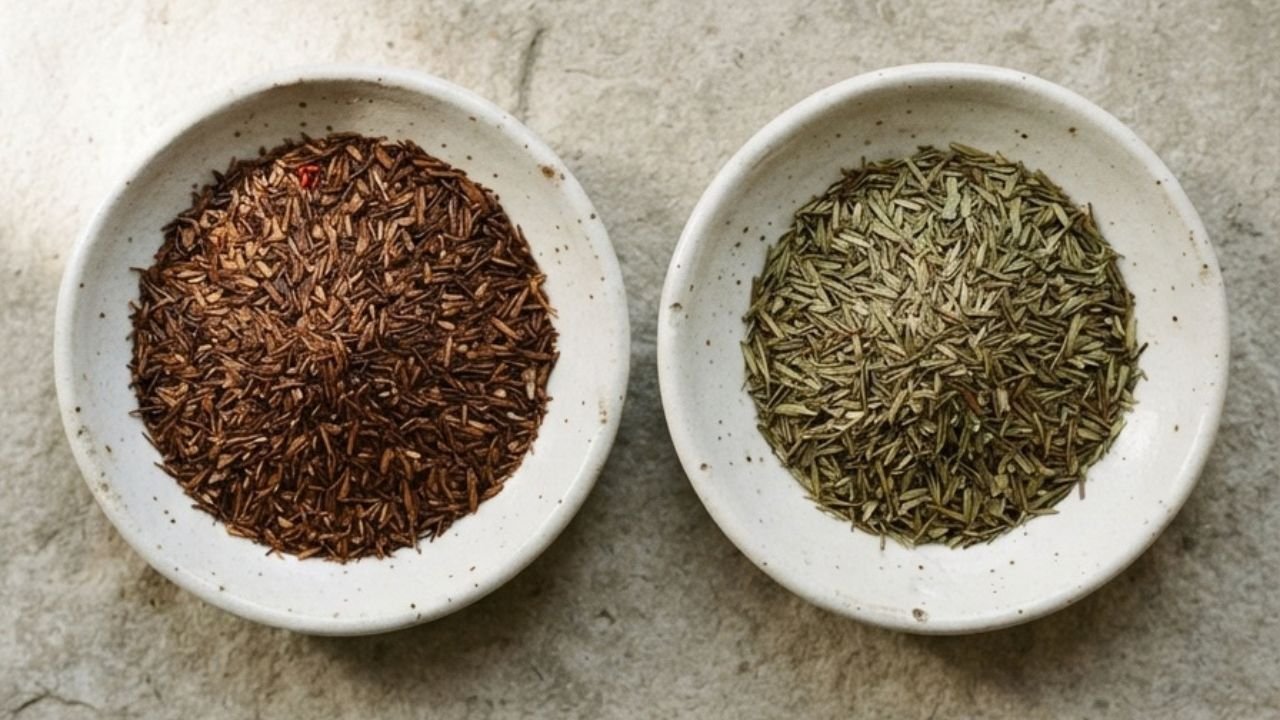
Red Rooibos and Green Rooibos Are Not Quite the Same
The red rooibos most people recognise gets its characteristic colour through oxidation during processing. Green rooibos skips that stage and remains closer to its original green appearance.
The difference is more than visual. Processing changes the plant’s chemical composition, so the two versions can have different profiles of naturally occurring compounds.
That still does not make green rooibos automatically superior.
Choosing between them can remain a matter of flavour and preference unless you have a specific reason to consider their different compositions. A greener colour is not, by itself, evidence that something is healthier.
A Few Sensible Habits Make Daily Use Easier
- Treat rooibos as a beverage first. This keeps ordinary tea separate from concentrated extracts and supplements.
- Avoid chasing a perfect number of cups. There is no universal figure that needs to govern everyone’s routine.
- Keep your overall drinks varied. Rooibos can be part of the day without becoming the entire day.
- Be more cautious with concentrated forms. Extracts and supplements deserve more attention than ordinary tea.
- Consider your medication routine. Regular use is worth mentioning to a healthcare professional when medicines are involved.
- Notice unusual reactions. If something changes after introducing a new drink or supplement, don’t automatically dismiss the connection.
- Don’t confuse caffeine-free with consequence-free. They describe different things.
- Be especially measured with very large quantities. More of a familiar drink is not automatically better simply because the drink itself seems gentle.
The Details People Usually Skip
Can rooibos become part of an everyday routine?
Yes, ordinary rooibos can fit into a regular beverage routine. The more useful consideration is how much you drink and whether you are also using concentrated rooibos products.
FAQ’s
1. Are rooibos naturally caffeine-free?
Yes. Natural rooibos does not contain caffeine, which is one reason it is commonly chosen as an alternative to traditional tea.
2. Is red rooibos better than green rooibos?
Neither should automatically be labelled the better choice. They undergo different processing, which affects their composition, colour, and character.
3. Is drinking more rooibos necessarily better?
No particular increase should be assumed to provide a greater benefit. The evidence does not support treating higher consumption as a simple “more is better” equation.
4. Can rooibos be used with medication?
It depends on the medication and the amount and form of rooibos involved. Anyone taking regular medication should check with a pharmacist or doctor before making concentrated rooibos products part of their routine.
5. Are rooibos extracts the same as rooibos tea?
No. An extract is a concentrated product, while ordinary rooibos tea is consumed as a beverage. They should not automatically be treated as having identical effects or considerations.
Keep the Ritual Simple
Rooibos does not need to carry the weight of a miracle-health story to remain interesting. Its South African roots, naturally caffeine-free character, distinctive red colour, and place in modern tea culture already give it a reason to stay in the cupboard.
The safest everyday relationship with it is also the least dramatic: enjoy ordinary rooibos in reasonable amounts, understand that concentrated products are a different matter, and give extra thought to medication or unusual personal circumstances. A good daily habit does not need to promise more than the drink can reasonably deliver.