Boysenberry is one of those fruits people recognize before they can explain. It looks between a blackberry and raspberry, with a long shape and deep reddish-purple colour when ripe. Its name comes from Rudolph Boysen, the California horticulturist linked to the plant, while its story later became tied to Walter Knott and Knott’s Berry Farm.
The problem is that boysenberry is often confused with other berries, leaving its real origins, flavour, and identity unclear. This article clears up those details.
The part of the story that never became completely tidy
The boysenberry’s origin story is less like a clean invention and more like a trail of horticultural experiments. Rudolph Boysen worked with berry plants in California during the early twentieth century. At some point, plants associated with him produced the fruit that would later carry his name. The surviving vines eventually came to the attention of George M. Darrow, a berry specialist with the United States Department of Agriculture, who worked with Walter Knott to locate and propagate them.
That detail matters because Boysen did not simply create a famous commercial fruit and watch it become successful. The surviving plants needed to be found, cultivated and developed before the berry could reach a wider public.
It also explains why the berry’s parentage is often described differently depending on where you encounter the story. Its history predates the precise genetic record-keeping that would make such questions easy to settle.
Seven details that make the boysenberry different
1. Its name tells only part of the story
“Boysenberry” sounds as though it should describe a particular botanical category, but the name is essentially a tribute to Rudolph Boysen. The fruit belongs to Rubus, a large and complicated group of brambles. Within that group, hybrids can share characteristics with several familiar berries, which is one reason boysenberry can look immediately recognizable without being easy to classify casually.
Its name is therefore more historical than descriptive.
2. The famous family tree has some loose branches
You will often see boysenberry described as a cross involving blackberry, raspberry and loganberry.
That is the convenient version.
The deeper story is less certain. Historical accounts and horticultural discussions have not produced one perfectly settled pedigree. Loganberry and trailing blackberry ancestry are frequently discussed, while the role of raspberry is part of the traditional explanation.
For readers, the key distinction is simple. Boysenberry is a hybrid berry with a complicated background, not simply a large blackberry with a different name.
3. Its colour gives away its character
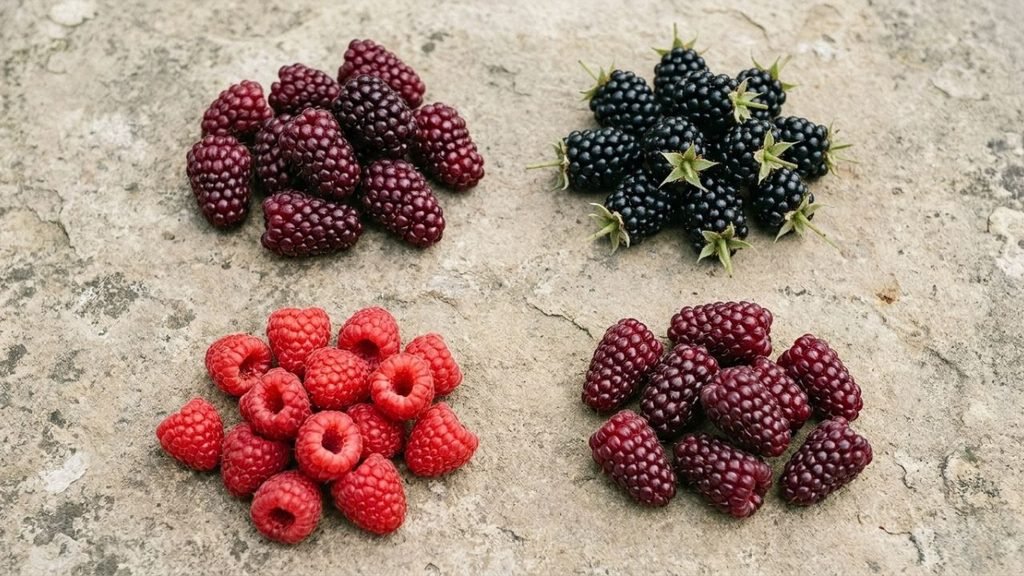
A ripe boysenberry usually sits in a darker colour range than a typical raspberry. Depending on ripeness and variety, it can move from red-purple toward a deep wine-like shade.
That colour is more than decoration. It immediately separates the fruit visually from the brighter red of a raspberry and the almost black appearance of many blackberries.
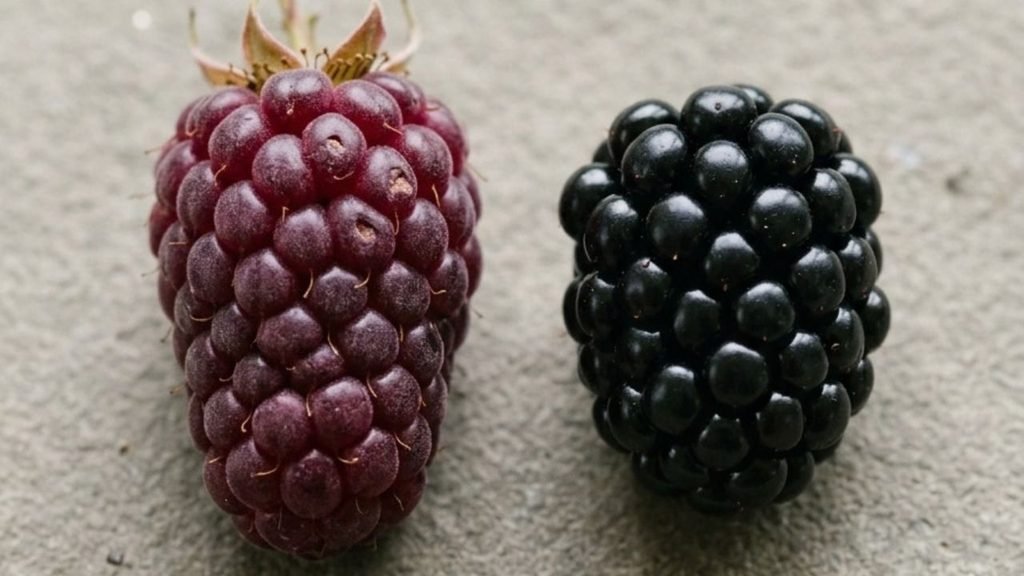
Look closely and another detail becomes obvious. The surface is made up of many small rounded drupelets. It resembles a blackberry because both belong to the same botanical family, but boysenberries tend to be longer and softer in appearance.
4. The flavour sits between familiar berry categories
Trying to describe boysenberry with one comparison usually makes the explanation less useful.
It has the dark, slightly sharp character people associate with blackberries, but it can also have the fragrant, bright quality associated with raspberries. The result is fuller and more complex than simply calling it “a sweet berry.”
Ripeness makes a noticeable difference. A less mature fruit can seem sharply tart, while a fully ripe one develops a deeper sweetness and stronger aroma.
That balance is one reason people who already know the usual raspberry-blackberry spectrum often find boysenberry distinctive.
5. Softness is one of its defining characteristics
A boysenberry does not have the firm, resilient appearance of fruit designed to sit around for days.
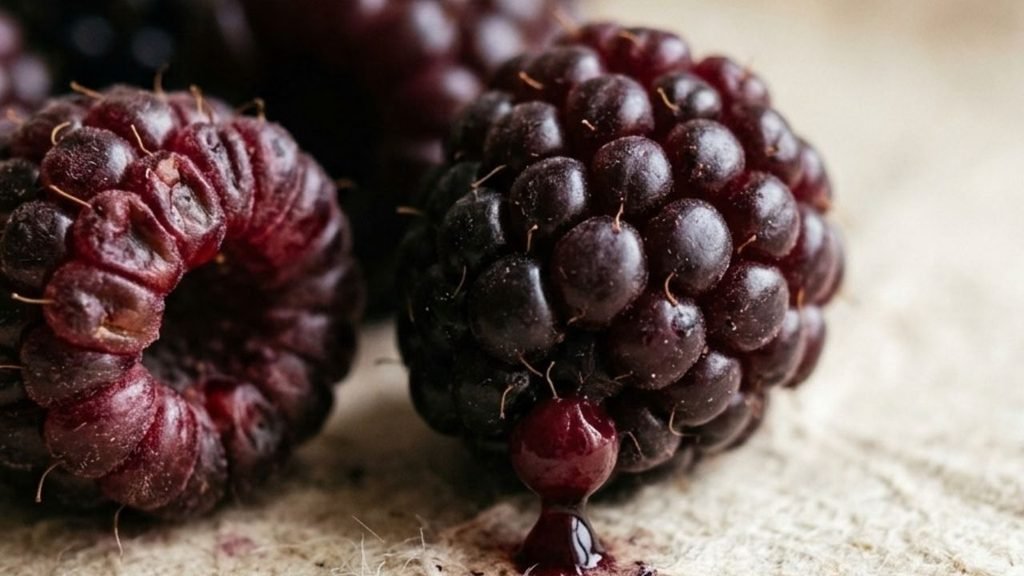
Its skin is delicate, and ripe fruit can be easily damaged. That softness is part of the eating experience, but it also helps explain why fresh boysenberries have never become as commonplace as blackberries or raspberries.
There is a useful lesson here. A fruit’s commercial success depends on more than flavour. Durability, transport, seasonality, and shelf life can all affect whether it becomes an everyday supermarket fruit or stays relatively uncommon.
6. Walter Knott changed the berry’s cultural story
The boysenberry became particularly important to Walter Knott, who propagated the surviving plants and began selling the fruit.
The berry became closely associated with Knott’s farm in Buena Park, California. That farm eventually developed into Knott’s Berry Farm, making the boysenberry an unusual example of a food becoming part of a much larger cultural and commercial identity.
The connection still exists in the name and traditions surrounding the park.
For a berry, that is an unusually large cultural footprint.
7. Its story is partly about preservation
The boysenberry might be better understood as a fruit that survived through human attention than as a perfectly documented horticultural invention.
Someone cultivated it Someone noticed its qualities. Someone preserved plants that might otherwise have disappeared Someone else found a way to introduce it to a much larger audience.
That chain is easy to overlook because the finished fruit now seems ordinary.
But the boysenberry’s history shows how many familiar foods depend on people making decisions long before consumers ever see them in a shop.
How to recognize one without confusing it with a blackberry
The easiest mistake is assuming that every large dark berry is a boysenberry.
Look at several details together rather than relying on colour alone.
A boysenberry is generally elongated, with a softer appearance and a reddish-purple to deep-purple colour when mature. Blackberries can be rounder or more compact, although shape varies considerably among varieties.
The flavour is another clue. Boysenberry tends to have a pronounced tartness balanced by a darker sweetness and a noticeable berry aroma.
There is no need to treat the identification like a botanical examination. The combination of shape, colour, softness and flavour gives a much better indication than any single characteristic.
What to look for when buying or choosing boysenberries
If you encounter fresh boysenberries, appearance can tell you quite a lot.
Look for boysenberries with deep, even colour and a plump shape rather than fruit that looks collapsed, leaking, or badly bruised. Some softness is normal, but damaged berries should be avoided. For broader context on how quickly fresh produce can deteriorate and what signs to watch for, see USDA guidance on storing fresh fruits and vegetables.
For frozen or preserved boysenberries, the useful question is less about appearance and more about what form you actually want. Whole berries, puree and other forms behave differently, so the label matters more than assuming every boysenberry product represents the same thing.
A few misconceptions worth clearing up
The first misconception is that boysenberry is simply a blackberry variety. It is not that straightforward. It belongs to the same broad botanical group, but its hybrid history gives it a different identity.
The second is that its ancestry is completely settled. It isn’t. The commonly repeated parentage is a useful background, but the historical record is not as precise as the simplified family tree suggests.
The third is that the name means the berry was invented entirely by Rudolph Boysen. His connection is central to the name and history, but the later work of locating, propagating and commercializing the plants was equally important to the fruit’s survival.
These distinctions make the story more interesting, not less.
FAQ’s
1. Is boysenberry a blackberry?
No. It is a hybrid Rubus fruit and is closely related to blackberries, but it is not simply another name for a blackberry.
2. Why is it called boysenberry?
The name comes from Rudolph Boysen, the horticulturist associated with the berry’s early development.
3. What does boysenberry taste like?
It is usually described as a balance of tartness, sweetness and strong berry aroma, with characteristics that can remind people of both blackberries and raspberries.
4. Is boysenberry the same as loganberry?
No. Loganberry is a separate hybrid berry, although loganberry is commonly mentioned when the ancestry of boysenberry is discussed.
5. Why don’t I see fresh boysenberries everywhere?
The fruit is particularly delicate, which makes handling and transportation more difficult than with firmer berries. This helps explain its more limited fresh-market presence.
The berry is more interesting once the simple story falls away
Boysenberry does not need an elaborate mythology to be interesting. Its appeal is in the details, from its soft hybrid fruit and the horticulturist behind its name to its unclear family tree and unexpected connection to one of America’s best-known theme parks.
It also offers a useful reminder about food history. Fruits that seem ordinary today are often the result of years of selection, preservation and human curiosity. The boysenberry simply happens to have left more of that story visible.